Wednesday, October 5, 2011

Israel (Bruchim Habaim)

          The country of Israel offers plenty of opportunity for adventure, fine dining, or just plain fun. It is an ancient country with many exotic locales that encompass a wide area of historical places. Visit Jerusalem, with it's ancient temples and cultural diversity. Learn about the Crusades in the port city of Acre. If you prefer 21st century fun, I advise you to travel to Tel Aviv and take advantage of the night life. Indulge under the Mediterranean sun in Caesarea and learn about the marvelous ancient architecture commissioned by Herod.. The weather is moderate, the people are friendly and the food is great!


Brief Background:

          The nation of Israel is situated in the Middle East surrounded by Egypt, Jordan, Syria and Lebanon. I had the pleasure of visiting Israel numerous times beginning with a port of call with the U.S. Navy. Out of all the places in my visit Jerusalem resonated with me the most. It's majestic temples combined with different historical periods all in one geographical location. On one corner near the old city walls you can catch a glimpse of Muslim pilgrims visiting the Temple Mount. Facing the Wailing Wall Jews offer prayers for guidance while Christians visit the different cathedrals within the old city walls. The country is full of history and offers many opportunities for fun in the sun. I marveled at the diversity that Israel has to offer. 

         The modern state of Israel was created in 1948 as a homeland for the Jews. Theodore Herze, a member of the Zionist movement initiated attempts to establish Israel. Under the Balfour Declaration of 1917 and support from the British Government, the creation of a Jewish homeland in the land of Palestine began to gain momentum. For detailed information please visit this link: http://www.state.gov/r/pa/ei/bgn/3581.htm#people

Jerusalem

          I approached the city walls in Jerusalem with amazement! The streets were packed with tourists and pilgrims from all over the world.  The aroma of fresh fruits, vegetables and roasted meat all add to the experience of travel. Like many ancient places the old city was constructed as a fortress, protecting the inhabitants and religious temples within the confines. Subterranean canals were built to allow for the flow of fresh water and in some cases to provide secret passages. The picture below illustrates an old channel built before the time of Christ. Remember Jerusalem is more than 5,000 years old. One cannot help but marvel at the engineering feat required to design, build and then implement these wonderful works for the benefit of all its inhabitants. Jerusalem is also heavily influenced by many other cultures including the Greeks, Romans, Byzantium, and European Christianity. Jerusalem definitely offers old world charm as you can see from the images.


          Take a look at the photo below! Our tourist guide told us that this is where the Last Supper supposedly took place. Notice that there is something strange with this theory. The answer lies within the architecture. The building has a Romanesque architectural design structure and it was built during the Crusades. Throughout the centuries many Christians visited Jerusalem as pilgrims to pray or collect sacred relics ( for example a piece of the cross, etc). The Crusades were wars fought between Christians and Muslims both claiming the Holy Land as a sacred place. These wars lasted for several centuries.  


Acre 

           Acre is situated in the northern part of Israel. The city is heavily influenced by Arabic cultures and makes it a prime location for sun bathing, dining, and more dining. If you like authentic foods Acre is the place to visit. The dishes are prepared with middle eastern spices coupled with vegetables and tasty meats. For seafood lovers there are plenty of fresh fish. Amidst the ruins left by the Crusading Knights, Acre offers excellent opportunities for souvenir collecting as well. Sitting with family and friends at the restaurant I could not help notice the local kids diving from the old city wall pictured below. I guess the water is not shallow around those parts! After lunch we visited the museum of the old Turkish Bath. The bath was a meeting place for many locals to conduct business, catch up on the latest gossip, or just relax. The people living in Acre are very friendly. Just walk through the streets and glimpse at the myriad of enticing colors, talk with the people, or just enjoy a cold glass of freshly squeezed lemons.


  Images of old city wall and arches from:


Photos from the market place in Acre:


Caesarea

The ancient port city of Caesarea is located between Tel Aviv and Haifa. The city was revitalized by King Herod the Great and named after his patron and benefactor Augustus Caesar. Many of the ancient buildings were commissioned by him and still stand to this day. The maritime port was the envy of the ancient world allowing merchant vessels to bring goods and trade, spurring the local economy. King Herod encouraged these activities but was not liked by the majority of his people.  


Roman Aqueduct courtesy of:
http://en.wikipedia.org/wiki/File:Caesarea.jpg                             


Take a look at this video which provides a glimpse of what Israel has to offer:
Video can be located at youtube: http://www.youtube.com/watch?v=Or476fgFnV4


"My contemporaries in Israel have a love for life that`s amazing. There, there is not the luxurious and rich existence of material goods of Hollywood films, every day they struggle to survive, but they still have an enthusiasm difficult to find elsewhere."

-Natalie Portman


Tuesday, October 4, 2011

Mongolia


The Ins and Outs of Mongolia


I never thought much about Mongolia until I saw a recent concert of AnDu Union, a celebration of music from Inner Mongolia.  It transported me to a place where magical things are found in sound as well as sight.  Velvet and mohair costumes, soft yet shielding, were worn by the singers and musicians that seemed to blend those same qualities of their garments with their music.   String instruments in concert with guttural vocals and whistles that you could swear came from an instrument or some techo-synthesized device that required a plug, came together seemingly at once in celebration and defense of an ancient tradition.  I returned to my seat, here at home in Montclair, NJ, a different person, having experienced the possibilities of the human voice and spirit – two qualities that couldn’t seem to be separated from these performers. 
 
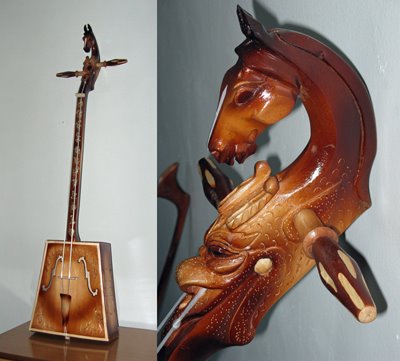
 The traditional throat singers (Hoomei), dressed in traditional costumes (standard of dressing still to this day), compliment the musical instruments, such as the horse-head fiddle (Morin huur).
I invite you to watch a video (or both) of AnDi Union, and take the journey for yourself.  You’ll be tempted to close your eyes, but don’t!  Let visions of the singers be a part of the ancient, visceral experience.  Step “in”. You’ll leave your “outer” self behind, I promise you:


Mongolia is the least populated country in the world, where one third of its inhabitants live in the capitol, Ulaanbaatar, leaving the rest of the country to be primarily semi-nomadic.  There are great stretches of wildlife, void of people and roads.  It is where the only remaining “wild” horses in the world reside (click here for more on Przewalski).   Elegant and free, these creatures know as Przewalski horses are a symbol of the wild nature of the country.  Mongolian Art, (including paintings, music, and instruments) honor the horse by making it their subject and emulating its nature.  Listen to the way the music in this clip integrates the horse into the song, as you watch the incredible footage of them in their natural habitat (or simply, in their country):
Perhaps that is why Mongolians hold fast to traditions, keeping them alive and not a hats off (no pun intended) to the past.  Mongolia remains an autonomous country, where traditional clothes are still worn simply because the people want to wear them.  They also choose to live off the wild life, using everything they hunt.  Mare’s milk is a staple product obtained by milking wild horses; prime examples of living off the wild.    As a tourist, you might encounter a milking, as one person documented the event did:
“Mongolia is divided into 21 aimags (Mongolian: аймаг, sometimes translated to province) and the capital, Ulaanbaatar. Each aimag is subdivided into several sums. The name aimag is derived from the Mongolian and Turkic languages word for ‘tribe’”


SUKHBAATAR SQUARE


If you decide to visit the capitol, Ulaabaator, you might be surprised by the metropolitan feel of the city, particularly Sakhbaatoar Square.  Named after Damdin Sukhbaatar, who “declared Mongolia's final independence from the Chinese…The Square now bears his name and features a statue of him astride his horse”.   Cosidered by many as the hero of the revolution, he encapsulated the movement in a speech, a passage from it engraved on the bottom of the statue: “'If we, the whole people, unite in our common effort and common will, there will be nothing in the world that we cannot achieve, that we will not have learnt or failed to do”. (http://legendtour 2011)


 GandanKhiid


"The full name, Gandantegchinlen, translates roughly as 'the great place of complete joy'" (http://www.w.lonelyplanet.com) and it is a fitting name for one of Mongolia's most important monasteries.  The building of the monastary began in 1838, and it continued to evolve through periods in history, ranging from a tourist attraction, void of any religious things going on, untiltoday, where it currently is occupied by over 600 monks
(http://www.lonelyplanet.com).  Just as traditional music has made its way back to Mongolian culture, religion returns; evident in the chants of the monks whose voices echo over the mountains. 


Khövsgöl Nuu National Park

Lakes.  Mountains.  Wildlife.  If these things appeal to you, than you will want to visit Khövsgöl Nuur National Park.  Known as the "Blue Pearl of the Mongolia, Khövsgöl Nuur is an extraordinary lake that stretches 136km deep into the Siberian taiga" making it a perfect location for this national treasure (http://www.lonelyplanet.com). Visitors can see exactly why Mongolians are so connected to nature by touring this park, representative of the vast wildlife found throughout Mongolia.


So, if you are not convinced yet, perhaps you can find out more about the provinces of Mongolia that most interest you. 

There are plenty of websites, like this one (click here for Mongolian resorts) , that provide tourist information.  Just click and go.


"Time is of the essence" commented Karen Campo, a veteran English language teacher, who has collectively spent ten years teaching in Mongolia over the past two decades.  "It could all change, due to China coming in and mining in Mongolia" she said with a sense of melancholy and realism.  "That means a changing culture; it's inevitable" were her sentiments, and I thought that it was fitting for this particular culture.  Mongolia has changed again and again over centuries, yet it has somehow returned to traditions, perhaps making the revitalization seem new.  Mongolians want to revive their ancient culture - it is something wild in them that can't  be tamed.   I knew after speaking with her that this is, indeed, the time to go! (excerpt from Paul Caruso's interview with Karen Campo, September 30, 2011)

For me it begins with music.  But it doesn’t end there.  The topography of Mongolia is as diverse as its culture, including   mountains, deserts, national parks, temples, animals, Buddhism, resorts and art.  As Nars, the  leader of the musical group AnDa Union says, “There is a wealth of folk music for us to learn; so far, our repertoire of songs is like a drop in the ocean”[i] I ask you to consider the following question:  What will your repertoire of experiences be?  Listen.


[i] Program notes, Peak Performances, Montclair State Universiry,  September 17, 2011.  Nars,  AnDa Union